Access Control Lists
Access Control Lists (ACLs) filter IP traffic and secure your network from unauthorized access. An ACL is a set of conditions that the NetScaler evaluates to determine whether to allow access. For example, the Finance department probably does not want to allow its resources to be accessed by other departments, such as HR and Documentation, and those departments want to restrict access to their data.
When the NetScaler receives a data packet, it compares the information in the data packet with the conditions specified in the ACL and allows or denies access. The administrator of the organization can configure ACLs to function in the following processing modes:
-
ALLOW—Process the packet.
-
BRIDGE—Bridge the packet to the destination without processing it. The packet is directly sent by Layer 2 and Layer 3 forwarding.
-
DENY—Drop the packet.
ACL rules are the first level of defense on the NetScaler.
NetScaler supports the following types of ACLs:
-
Simple ACLs filter packets based on their source IP address and, optionally, their protocol, destination port, or traffic domain. Any packet that has the characteristics specified in the ACL is dropped.
-
Extended ACLs filter data packets based on various parameters, such as source IP address, source port, action, and protocol. An extended ACL defines the conditions that a packet must satisfy for the NetScaler to process the packet, bridge the packet, or drop the packet.
Nomenclature
In the NetScaler user interfaces, the terms simple ACL and extended ACL refer to ACLs that process IPv4 packets. An ACL that processes IPv6 packets is called a simple ACL6 and or extended ACL6. When discussing both types, this documentation sometimes refers to both of them as simple ACLs or extended ACLs.
ACL Precedence
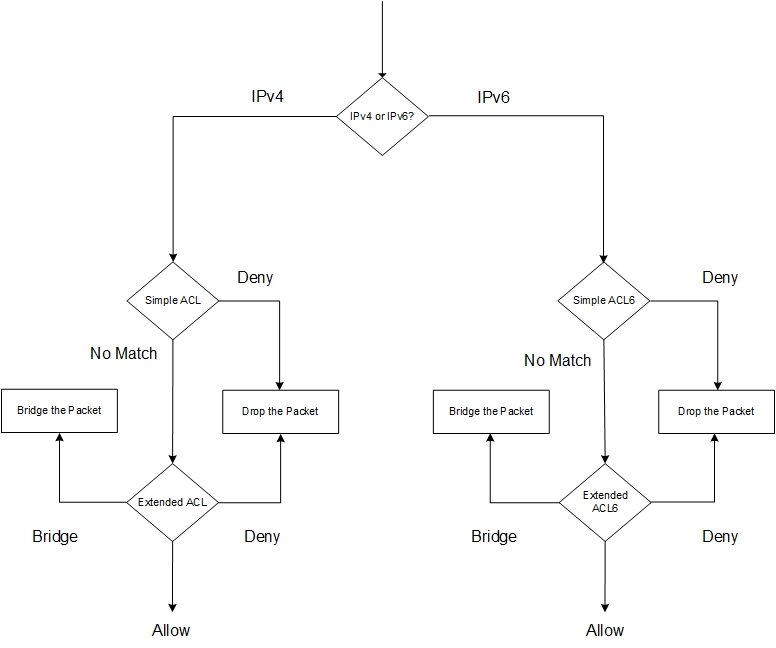
If both simple and extended ACLs are configured, incoming packets are compared to the simple ACLs first.
The NetScaler first determines whether the incoming packet is an IPv4 or an IPv6 packet, and then compares the packet’s characteristics to either simple ACLs or simple ACL6s. If a match is found, the packet is dropped. If no match is found, the packet is compared to extended ACLs or extended ACL6s. If that comparison results in a match, the packet is handled as specified in the ACL. The packet can be bridged, dropped, or allowed. If no match is found, the packet is allowed.
Figure 1. Simple and Extended ACLs Flow Sequence