
Global Server Load Balancing
Notes:
-
From release 13.0 build 41.x, global server load balancing (GSLB) deployments using the NetScaler appliance are fully compliant with DNS flag day 2019.
-
The GSLB feature is included with the NetScaler Advance and Premium edition licenses. The NetScaler option license is supported with the Standard edition.
NetScaler appliances configured for GSLB provide disaster recovery and ensure continuous availability of applications by protecting against points of failure in a WAN. GSLB balances the load across data centers by directing client requests to the closest or best performing data center, or to surviving data centers if there is an outage.
In a typical configuration, a local DNS server sends client requests to a GSLB virtual server, to which are bound GSLB services. A GSLB service identifies a load balancing or content switching virtual server, which can be at the local site or a remote site. If the GSLB virtual server selects a load balancing or content switching virtual server at a remote site, it sends the virtual server’s IP address to the DNS server. The DNS server sends it to the client. The client then resends the request to the new virtual server at the new IP.
The GSLB entities that you must configure are the GSLB sites, the GSLB services, the GSLB virtual servers, load balancing or content switching virtual servers, and authoritative DNS (ADNS) services. You must also configure MEP. You can also configure DNS views to expose different parts of your network to clients accessing the network from different locations.
Note:
To take full advantage of GSLB features, use ADC appliances for load balancing or content switching at each data center, so that your GSLB configuration can use the proprietary MEP to exchange site metrics.
Related information
GSLB deployment typesGSLB configuration entitiesGSLB methodsConfigure static proximityConfigure site-to-site communicationConfigure metrics exchange protocolConfigure GSLB by using a wizardConfigure GSLB entities individuallySynchronize the configuration in a GSLB setupSource IP address whitelisting for GSLB communication channelsGSLB dashboardMonitor GSLB servicesHow domain name system supports GSLBPriority order for GSLB servicesUpgrade recommendations for GSLB deploymentUse case: Deployment of domain name based autoscale™ service groupUse case: Deployment of IP address based GSLB service groupHow-to articles
How GSLB works
With ordinary DNS, when a client sends a domain name system (DNS) request, it receives a list of IP addresses of the domain or service. Generally, the client chooses the first IP address in the list and initiates a connection with that server. The DNS server uses a technique called DNS round robin to rotate through the IPs on the list. It sends the first IP address to the end of the list and promotes the others after it responds to each DNS request. This technique ensures equal distribution of the load, but it does not support disaster recovery, load balancing based on load or proximity of servers, or persistency.
When you configure GSLB on ADC appliances and enable MEP, the DNS infrastructure is used to connect the client to the data center that best meets the set criteria. The criteria can designate the following:
-
Least loaded data center
-
Closest data center
-
Data center that responds most quickly to requests from the client’s location
-
A combination of those metrics and SNMP metrics.
An appliance tracks the location, performance, load, and availability of each data center. It uses these factors to select the data center to send the client request.
The following figure illustrates a basic GSLB topology.
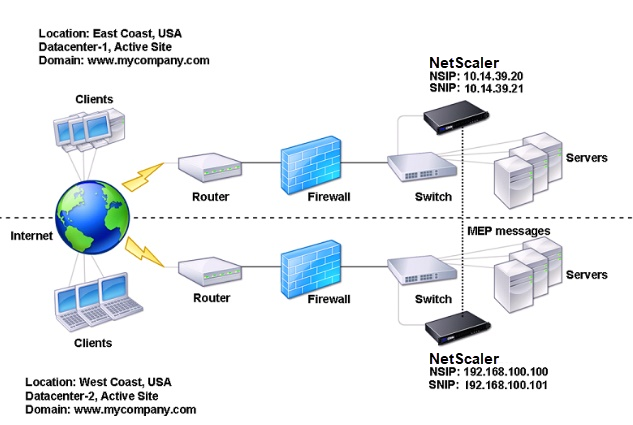
A GSLB configuration consists of a group of GSLB entities on each appliance in the configuration. These entities include GSLB sites, GSLB services, GSLB service groups, GSLB virtual servers, load balancing servers, content switching servers, and ADNS services.