
Remediate vulnerabilities for CVE-2020-8300
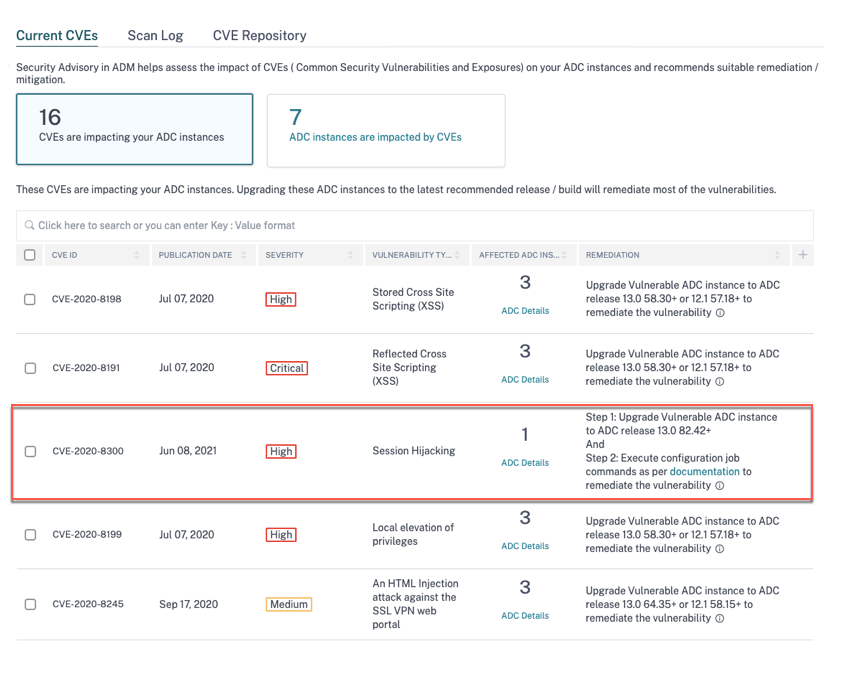
In the NetScaler Console security advisory dashboard, under Current CVEs >
<number of> NetScaler instances are impacted by CVEs, you can see all the instances vulnerable due to this specific CVE. To check the details of the CVE-2020-8300 impacted instances, select CVE-2020-8300 and click View Affected Instances.
Note
For more information about the security advisory dashboard see, Security Advisory.
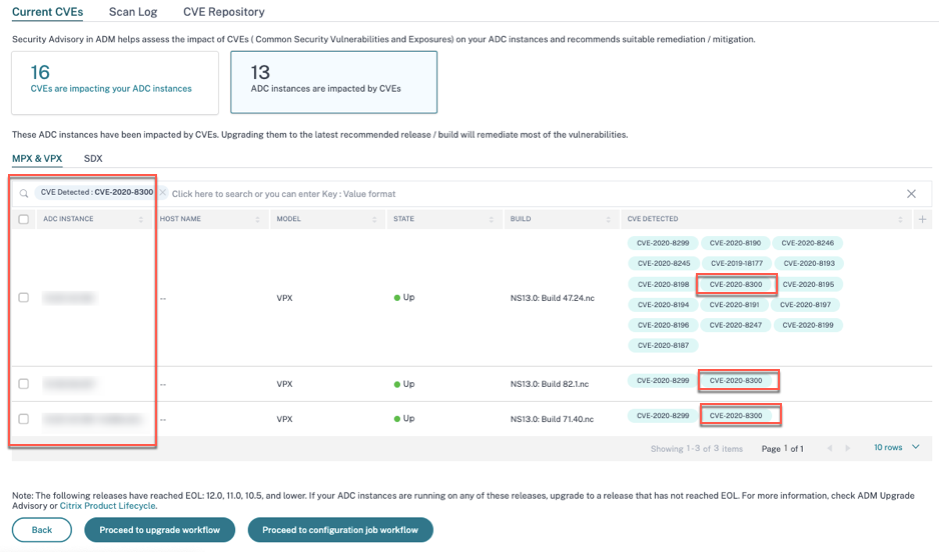
The
<number of> NetScaler instances impacted by CVEs window appears. Here you see the count and details of the NetScaler instances impacted by CVE-2020-8300.
Related information
Remediate CVE-2020-8300
For CVE-2020-8300-impacted NetScaler instances, the remediation is a two-step process. In the GUI, under Current CVEs > NetScaler instances are impacted by CVEs, you can see step 1 and 2.

The two steps include:
-
Upgrading the vulnerable NetScaler instances to a release and build that has the fix.
-
Applying the required configuration commands using the customizable built-in configuration template in configuration jobs. Follow this step for each vulnerable NetScaler one at a time and include all SAML actions and SAML profiles for that NetScaler.
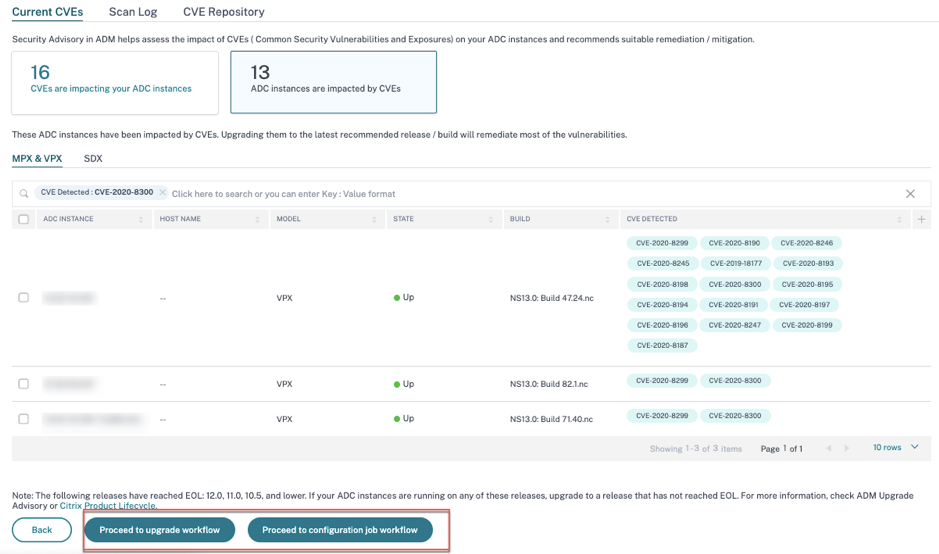
Under Current CVEs> NetScaler instances impacted by CVEs, you see two separate workflows for this 2-step remediation process: which are Proceed to upgrade workflow and Proceed to configuration job workflow.
Step 1: Upgrade the vulnerable NetScaler instances
To upgrade the vulnerable instances, select the instances and click Proceed to upgrade workflow. The upgrade workflow opens with the vulnerable NetScaler instances already populated.
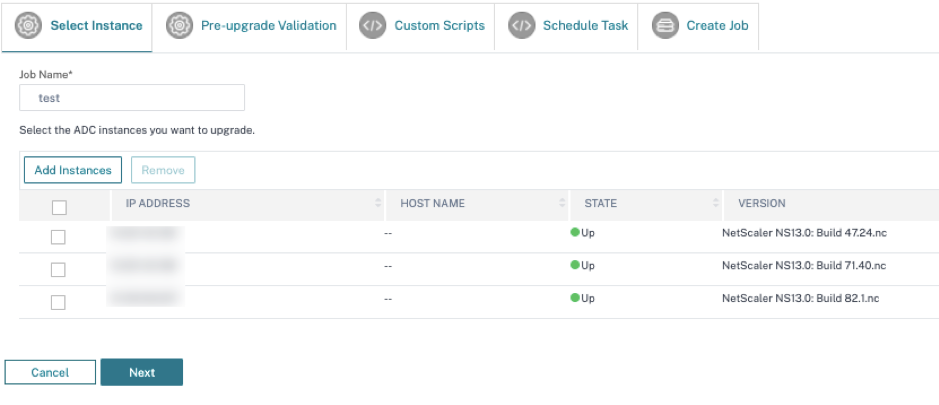
For more information on how to use NetScaler Console to upgrade NetScaler instances, see Create a NetScaler upgrade job.
Note
This step can be done at once for all the vulnerable NetScaler instances.
Step 2: Apply configuration commands
After you've upgraded the impacted instances, in the
<number of> NetScaler instances impacted by CVEs window, select one instance impacted by CVE-2020-8300 and click Proceed to configuration job workflow. The workflow includes the following steps.
-
Customizing the configuration.
-
Reviewing the auto-populated impacted instances.
-
Specifying inputs for variables for the job.
-
Reviewing the final config with variable inputs populated.
-
Running the job.
Keep the following points in mind before you select an instance and click Proceed to configuration job workflow:
-
For a NetScaler instance impacted by multiple CVEs (such as CVE-2020-8300, CVE-2021-22927, CVE-2021-22920, and CVE-2021-22956): when you select the instance and click Proceed to configuration job workflow, the built-in configuration template does not auto-populate under Select configuration. Drag and drop the appropriate config job template under Security Advisory Template manually to the config job pane on the right side.
-
For multiple NetScaler instances that are impacted by CVE-2021-22956 only: you can run config jobs on all instances at once. For example, you've NetScaler 1, NetScaler 2, and NetScaler 3, and all of them are impacted only by CVE-2021-22956. Select all these instances and click Proceed to configuration job workflow, and the built-in configuration template auto-populates under Select configuration.
-
For multiple NetScaler instances impacted by CVE-2021-22956 and one or more other CVEs (such as CVE-2020-8300, CVE-2021-22927, and CVE-2021-22920), which require remediation to be applied to each NetScaler at a time: when you select these instances and click Proceed to configuration job workflow, an error message appears telling you to run the config job on each NetScaler at a time.
Step 1: Select configuration
In the configuration job workflow, the built-in configuration template auto-populates under Select configuration.
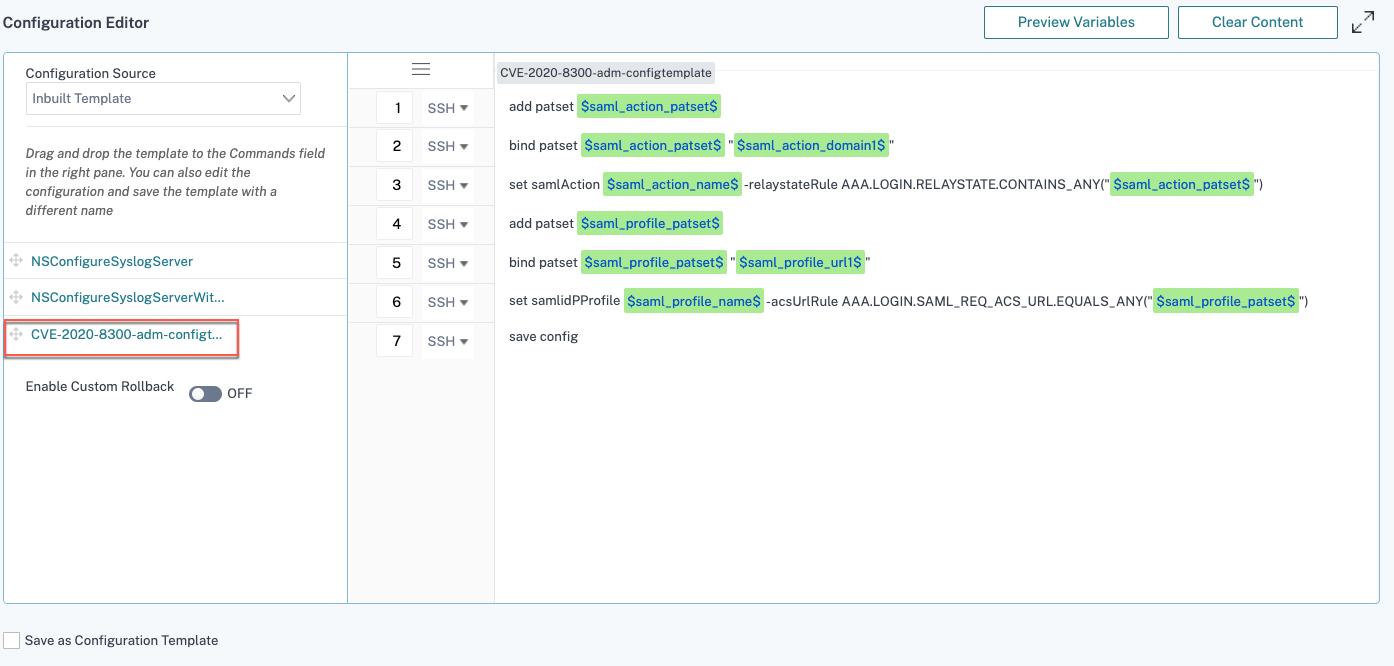
Run a separate configuration job for each impacted NetScaler instance, one at a time, and include all SAML actions and SAML profiles for that NetScaler. For example, if you have two vulnerable NetScaler instances each having two SAML actions and two SAML profiles, you must run this configuration job two times. One time per NetScaler covering all its SAML actions and SAML profiles.
| NetScaler 1 | NetScaler2 |
|---|---|
| Job 1: two SAML actions +two SAML profiles | Job 2: two SAML actions +two SAML profiles |
Give the job a name and customize the template for the following specifications. The built-in configuration template is only an outline or base template. Customize the template based on your deployment for the following requirements:
a. SAML actions and their associated domains
Depending on the number of SAML actions you have in your deployment, you must replicate lines 1–3 and customize the domains for each SAML action.
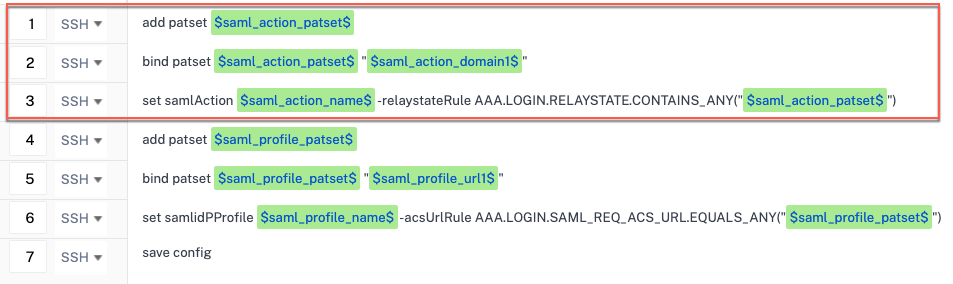
For example, if you have two SAML actions, repeat lines 1–3 two times and accordingly customize the variable definitions for each SAML action.
And if you have N domains for a SAML action, you must manually type the line
bind patset $saml_action_patset$ “$saml_action_domain1$” multiple times to ensure that the line appears N times for that SAML action. And change the following variable definition names:
-
saml_action_patset: is the config template variable, and it represents the value of the name of the pattern set (patset) for the SAML action. You can specify the real value in step 3 of the config job workflow. See the section Step 3: Specify variable values in this doc. -
saml_action_domain1: is the config template variable, and it represents the domain name for that specific SAML action. You can specify the real value in step 3, of the config job workflow. See the section Step 3: Specify variable values in this doc.
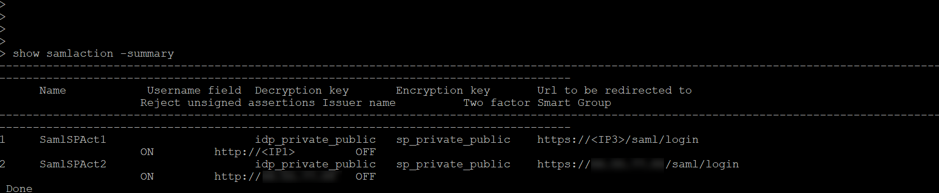
To find all the SAML actions for a device, run the command
show samlaction.
b. SAML profiles and their associated URLs
Depending on the number of SAML profiles you have in your deployment, replicate lines 4–6. Customize the URLs for each SAML profile.
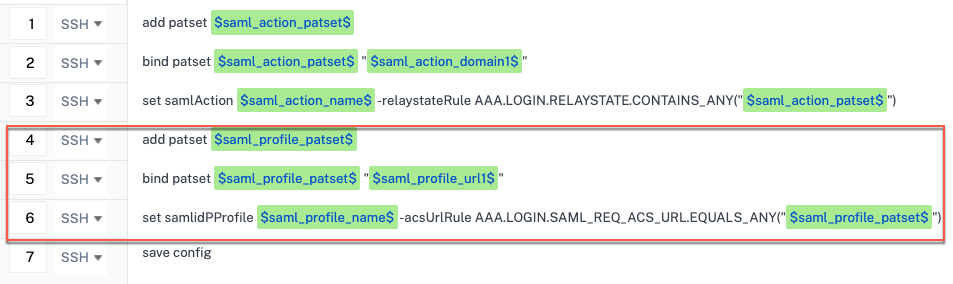
For example, if you have two SAML profiles, manually enter lines 4–6 two times and accordingly customize the variable definitions for each SAML action.
And if you have N domains for a SAML action, you must manually type the line
bind patset $saml_profile_patset$ “$saml_profile_url1$” multiple times to ensure that the line appears N times for that SAML profile. And change the following variable definition names:
-
saml_profile_patset: is the config template variable, and it represents the value of the name of the pattern set (patset) for the SAML profile. You can specify the real value in step 3, of the config job workflow. See the section Step 3: Specify variable values in this document. -
saml_profile_url1: is the config template variable, and it represents the domain name for that specific SAML profile. You can specify the real value in step 3, of the config job workflow. See the section Step 3: Specify variable values in this document.
To find all the SAM profiles for a device, run the command
show samlidpProfile.

Step 2: Select the instance
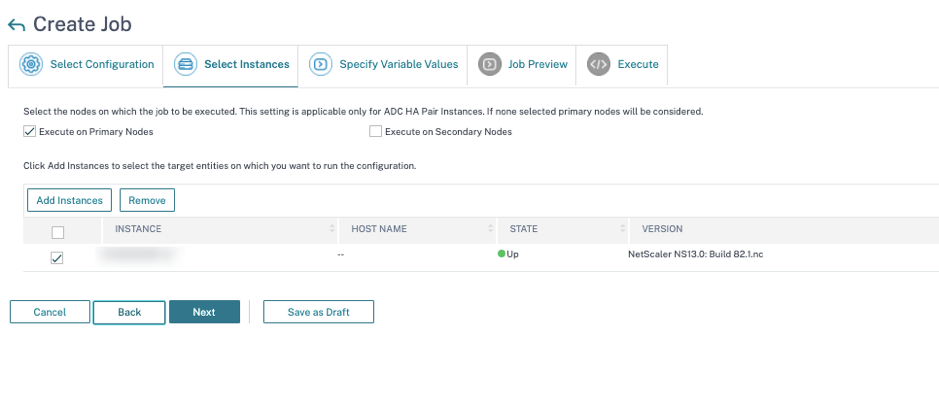
The impacted instance is auto-populated under Select Instances. Select the instance and click Next.
Step 3: Specify variable values
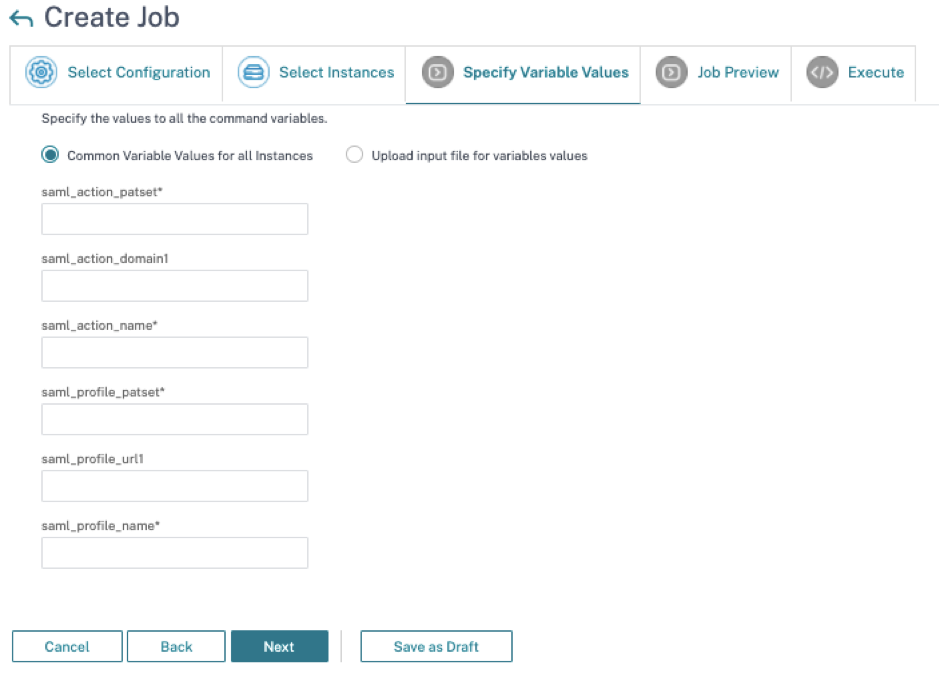
Enter the variable values.
-
saml_action_patset: add a name for the SAML action -
saml_action_domain1: enter a domain in the formathttps://<example1.com>/ -
saml_action_name: enter the same of the SAML action for which you are configuring the job -
saml_profile_patset: add a name for the SAML profile -
saml_profile_url1: enter the URL is this formathttps://<example2.com>/cgi/samlauth -
saml_profile_name: enter the same of the SAML profile for which you are configuring the job
Note
For URLs, the extension is not always
cgi/samlauth. It depends on what third-party authorization you have, and accordingly you must put the extension.
Step 4: Preview the configuration
Previews the variable values having been inserted in the config and click Next.
Step 5: Run the job
Click Finish to run the configuration job.
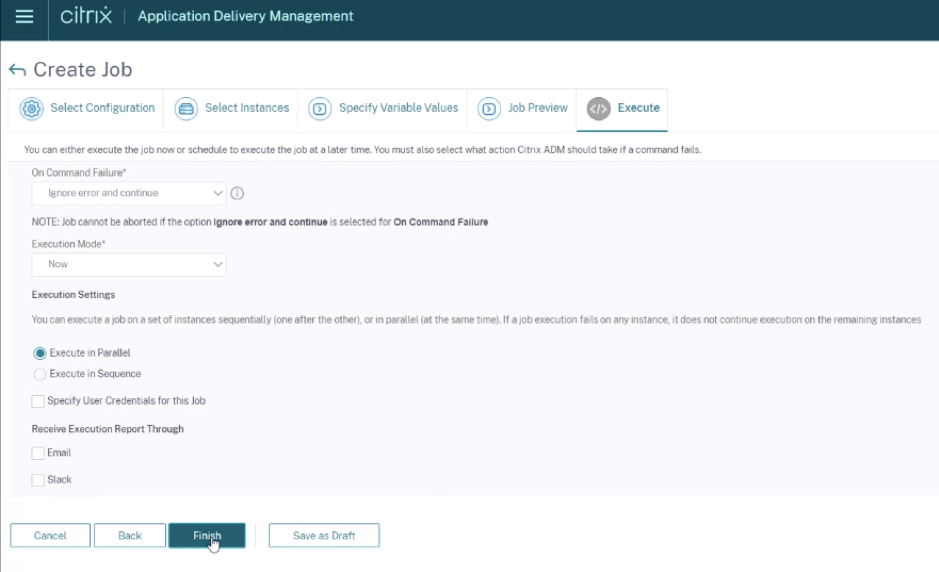
After the job is run, it appears under Infrastructure > Configuration > Configuration Jobs.
After completing the two remediation steps for all vulnerable NetScaler instances, you can run an on-demand scan to see the revised security posture.
Points to note for NetScaler Console Express account
The NetScaler Console Express account has limited features, which include limitations of two configuration jobs only.
For CVE-2020-8300 remediation, you must run as many configuration jobs as the number of your vulnerable NetScaler instances. So, if you have an Express account and need to run more than two configuration jobs, follow this workaround.
Workaround: Run two configuration jobs for two vulnerable NetScaler instances and then delete both the jobs to continue running the next two jobs for the next two vulnerable NetScaler instances. Continue this until you have covered all vulnerable instances. Before deleting the jobs, you can download the report for future reference. To download the report, under Network > Jobs, select the jobs and click Download under Actions.
Example: If you have six vulnerable NetScaler instances, run two configuration jobs on two vulnerable instances respectively and then delete both the configuration jobs. Repeat this step another two times. At the end, you would have run six config jobs for six NetScaler instances respectively. In the NetScaler Console UI under Infrastructure > Jobs, you see only the last two configuration jobs.
Scenario
In this scenario, three NetScaler instances are vulnerable to CVE-2020-8300 and you need to remediate all the instances. Follow these steps:
-
Upgrade all the three NetScaler instances by following the steps given in the Upgrade an instance section in this document.
-
Apply the config patch to one NetScaler at a time, using the configuration job workflow. See the steps given in the Apply configuration commands section in this document.
The vulnerable NetScaler 1 has the following configuration:
| Two SAML actions | Two SAML profiles |
|---|---|
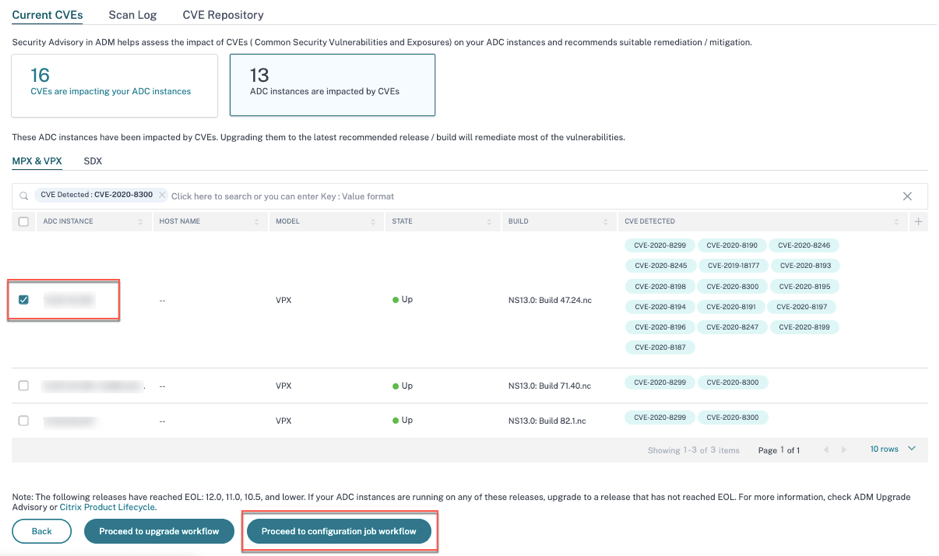
Select NetScaler 1 and click Proceed to configuration job workflow. The built-in template auto-populates. Next, give a job name and customize the template according to the given configuration.
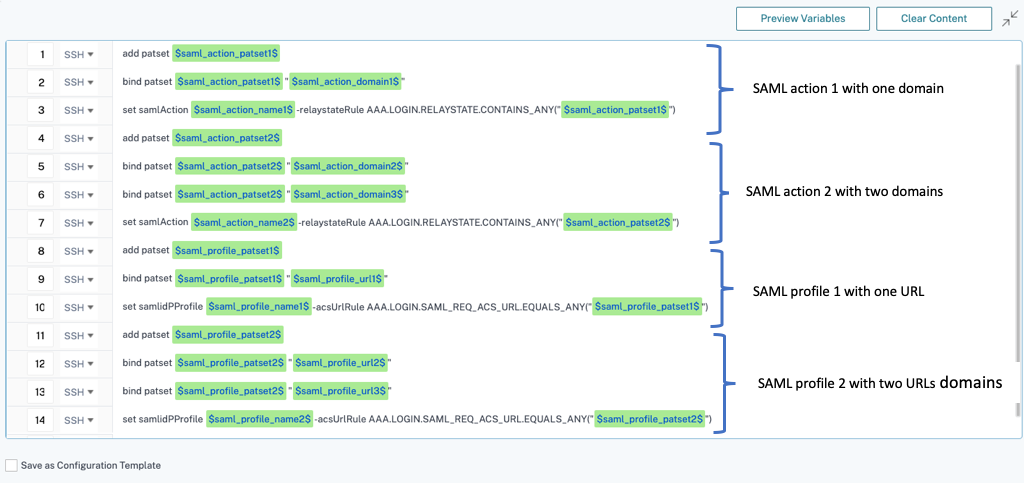
The following tables list the variable definitions for customized parameters.
Table 1. Variable definitions for SAML action
| NetScaler configuration | Variable definition for patset | Variable definition for SAML action name | Variable definition for domain |
|---|---|---|---|
| SAML action 1 has one domain | saml_action_patset1 | saml_action_name1 | saml_action_domain1 |
| SAML action 2 has two domains | saml_action_patset2 | saml_action_name2 | saml_action_domain2, saml_action_domain3 |
Table 2. Variable definitions for SAML profile
| NetScaler configuration | Variable definition for patset | Variable definition for SAML profile name | Variable definition for URL |
|---|---|---|---|
| SAML profile 1 has one URL | saml_profile_patset1 | saml_profile_name1 | saml_profile_url1 |
| SAML profile 2 has two URLs | saml_profile_patset2 | saml_profile_name2 | saml_profile_url2, saml_profile_url3 |
Under Select Instances, select NetScaler 1 and click Next. The Specify Variable Values window appears. In this step, you need to provide values for all the variables defined in the previous step.
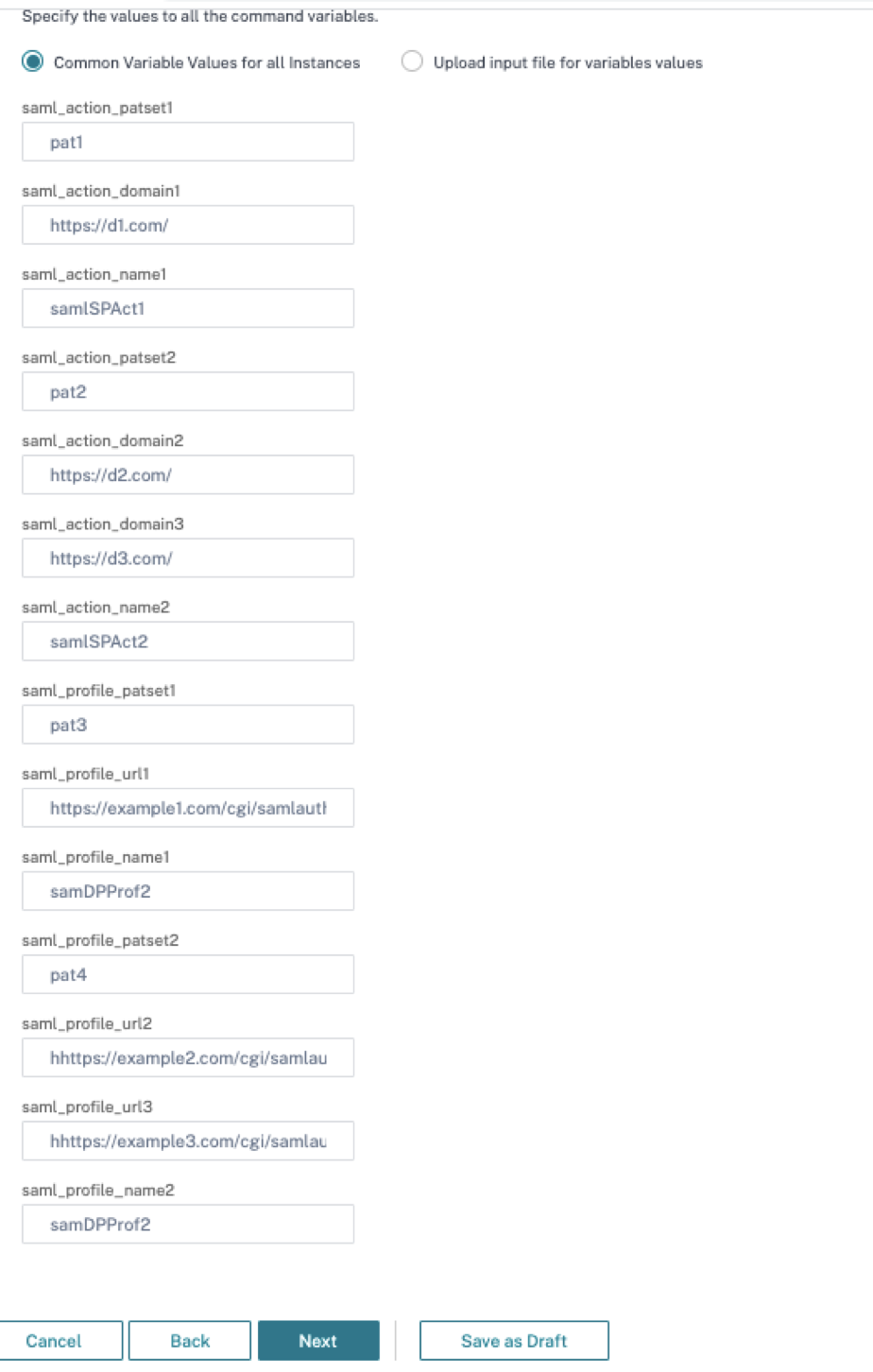
Next, review the variables.
Click Next and then click Finish to run the job.
After the job is run, it appears under Infrastructure > Configuration > Configuration Jobs.
After completing the two remediation steps for NetScaler1, follow the same steps to remediate NetScaler 2 and NetScaler 3. After remediation is complete, you can run an on-demand scan to see the revised security posture.